
To read the article in your language, please activate the translator in your browser, thank you very much for reading!
Para leer el artículo en tu idioma, activa el traductor en tu navegador. ¡Muchas gracias por leernos!
I went to Kyoto because I wanted to try Kintsugi
Kintsugi is the name of a technique for joining together broken or chipped items using lacquer and gold powder. It is a technique passed down since ancient times, and its history is very long.
Anna, who had been wanting to try Kintsugi for years, and Ryo, who has lived in Japan for a long time and has seen Kintsugi often but never tried it himself. We decided, "Let's go do Kintsugi together!" and set off on a trip to Kyoto.
There are many places in Kyoto where you can experience Kintsugi. Some are geared towards tourists, while others offer more serious, in-depth training. The ones for tourists are quick and easy but can be a bit pricey. In comparison, the professional ones usually require a three-day commitment or enrolling in a class.
Since it's quite difficult to commute from Osaka to Kyoto more than twice, this time we looked for a "one-day completion" course.
This turned out to be surprisingly hard to find!
The place we finally managed to find was Kristina Mar pottery studio in Katsura, Kyoto.
The teacher is a ceramic artist from Portugal. I had a good feeling about it.
Spain and Portugal are neighbors. She is also someone who has lived in Japan for a long time. Thinking, "She's a great senior to Anna (in many ways)!", I booked it immediately.
A wonderful, calm studio
Kristina Mar's studio was located about 15 minutes by bus from Hankyu Kyoto Line's Katsura Station.
It was a place with a quiet atmosphere, perfectly described as a peaceful residential area.
After climbing a small hill, we arrived in front of the specified address.
Kristina Mar (whose real name is Marta), who opened the door to welcome us, was a calm and lovely woman.
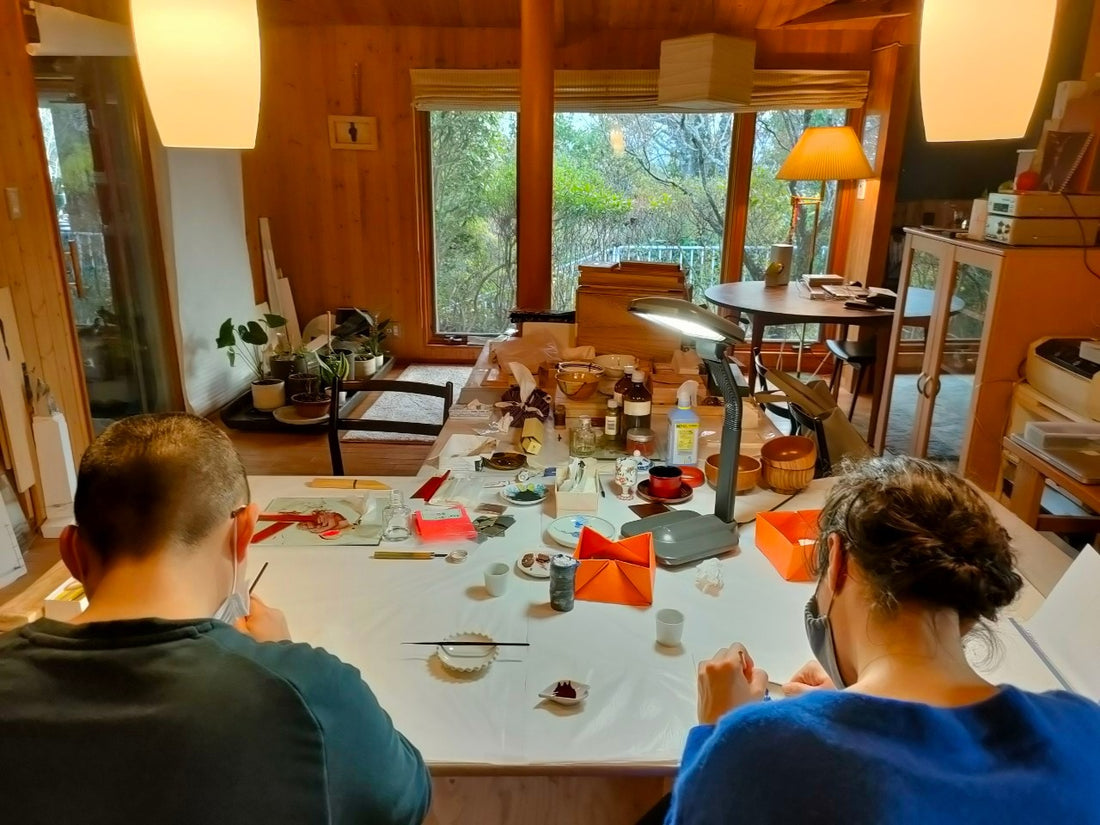
Once you step inside, it is a serene space where ceramic works and wood are balanced wonderfully. Both Anna and I exclaimed, "It's so beautiful!"
The deep history and method of Kintsugi
The history of Kintsugi is old, and it seems that repairs using lacquer have existed since the Jomon period.
The Jomon period was from about 13,000 to 2,300 years ago!!

Joining with lacquer means using something made from the resin of the lacquer tree as an adhesive. Originally, it was a technique used to connect wooden products when they broke or chipped. It is said that in the Muromachi period, people started covering it with gold powder. It's a combination of the "Makie" technique, which already existed in the Heian period, and the "Urushi" (lacquer) technique.
I thought it was a technique from China, but it seems that Kintsugi, which covers joints with gold powder, is a traditional Japanese technique.
I had no idea! I learned a lot.
Use lacquer resin to attach, and finally sprinkle gold powder over it.
That is Kintsugi explained in a nutshell.
The lacquer tree is famous because if you touch it, you get a rash immediately. In severe cases, you have to go to the hospital. Therefore, extreme caution is required when working with lacquer.
I heard that you simulate very carefully how to move your hands, how to attach pieces, and how to hold the dish.

Then, once decided, you perform the work quickly before the lacquer dries.
There is no wasted movement.
I think just watching these movements is art in itself.

And then, we moved on to the process of sprinkling gold powder, but this time, we worked slowly and held our breath.
Why?
If you move quickly, the gold powder will scatter!
*(The gold powder illuminated by the lights is incredibly beautiful, but it's not good for your health if you inhale it.)*


The time spent doing Kintsugi with such enthusiasm was incredibly luxurious. Most of all, I am very grateful to Marta, who taught us the manners, tools, history, and methods so carefully.
The natural beauty of the incomplete
Japan's unique "beauty" often finds value in admiring natural things that are not complete. Perfect symmetry does not exist in the natural world. Therefore, it is a culture that loves and cherishes incomplete forms. And I think the spirit of "Mottainai" (avoiding waste) is also very Japanese.
So, let's reuse things that have been chipped or broken. And if we are going to reuse them, let's make them a bit beautiful. I think that is the fundamental heart of Kintsugi.
The Kintsugi we experienced ourselves didn't result in a "perfect work of art," but it changed into something with character and charm.


By adding a little effort, we make things usable for a long time again.
I can see why Kintsugi is back in the spotlight all over the world. It really is the spirit of ecology.
If you would like to try it once, please visit Kristina Mar's Kintsugi experience when you come to Kyoto. You can also try pottery there.

Kristina Mar and Anna & Ryo from Ceramic Tocoton
[Kristina Mar Studio]
https://kristinamar8.wixsite.com/kristinamarartstudio
She can speak Japanese, English, Portuguese, Spanish, and French.
Thanks to her incredibly easy-to-understand explanation, I was able to discover a new world of Kintsugi. Thank you, Marta!