
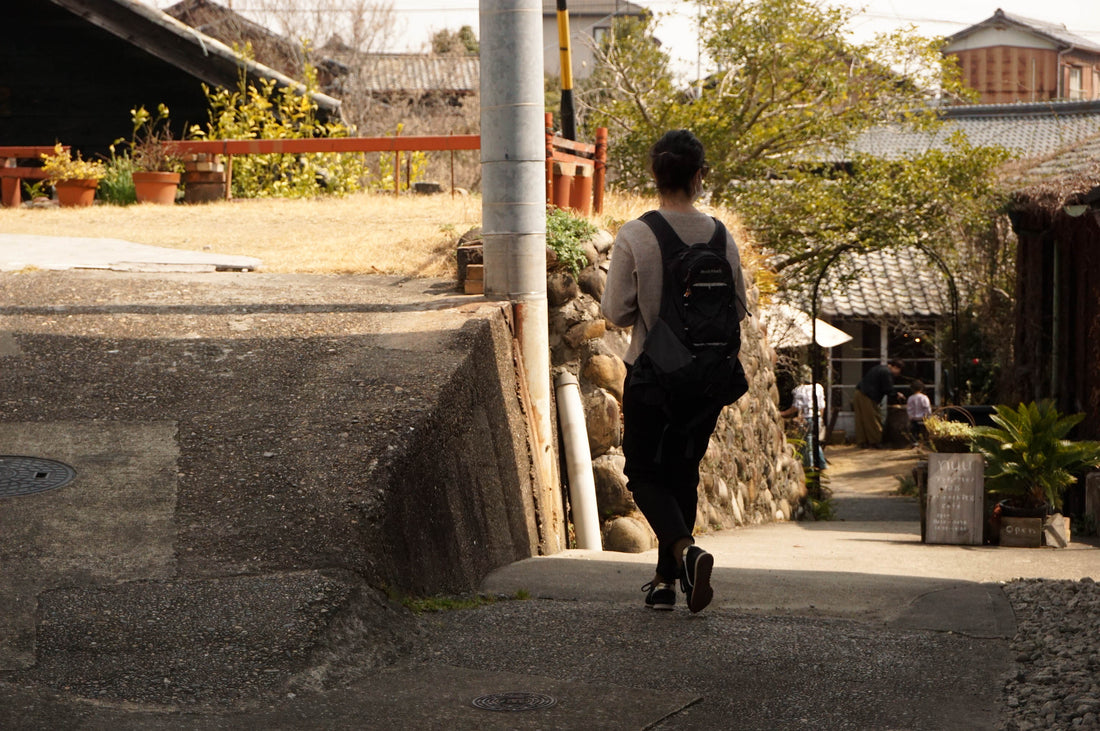
Last March, Ryo and I went to Tokoname, a city located in Aichi Prefecture, Japan. I had read that it was on the list known as "The Six Ancient Kilns," which groups the six most notable pottery production centers (Bizen, Echizen, Seto, Shigaraki, Tamba, and Tokoname) according to their creator, Koyama Fujio. Although I believe this classification does not include many other interesting places one could go to learn about traditional ceramics, it is an interesting guide to start exploring the history and techniques of the art of clay in Japan.

We arrived in Tokoname by train from Nagoya. At the station, there was an information center where we went to pick up a map of the area. It recommended a route through spots related to ceramics. Although we preferred to do our own thing (if we found a place we liked, we wanted to spend time there even if we missed others), we decided we didn't want to miss visiting the Toei kiln and the INAX Museum. I was interested in learning about the more industrial side of ceramic production, and these were two key points to learn from and enjoy.

We started walking toward the oldest part of the city, the old town of Tokoname. Following the road, we arrived under a bridge where works dedicated to the maneki-neko, the lucky cat, were displayed in a row, attached to a wall. The pieces were from artists all over the world, and the cats were represented in very different styles.

Once past the row of maneki-neko, we turned right to climb to the top of the small hill where the town has rested for many centuries. Pottery activity in Tokoname has been documented since the Heian period (794–1185), and although structures from that far back are not preserved, the long presence of the craft means that every few steps you encounter workshop-houses, abandoned kilns, disused or active chimneys, and pieces reused as urban furniture. Tokoname is, in itself, ceramics.

Surrounded by dark-colored houses half-mimicked by nature, we plunged deep into the narrow paths of the town. Before long, our attention was drawn to an abandoned brick kiln. It was the size of a small forest cabin; one could stand up inside it. Plants had climbed the walls, and a truly mysterious presence could be felt around it. When we approached to look inside, we were able to see a few water pipes placed as if they had just been fired. Later, as we explored the area, we would see dozens of pipes used not only to channel rainwater into the sewer but also to support the earthen slopes upon which the houses were installed.

Inside the kiln, there was also a small altar for making offerings. The kiln was considered a god. Animism is still present in Japan, and before starting to fire pieces, an offering is usually made to the kiln so that it protects the work done, produces a good fire, and makes the batch a success. Even though the kiln was out of use, its soul still resided in the darkness of its depths.
We deviated from the main path to approach a giant figure that, once again, represented a maneki-neko. From the top of the bridge we had seen from the road, the cat's unsettling eyes monitored the cars speeding past. Later, I understood that the production of these cats was also part of the city's ceramic industry and that this was why so many spaces had been dedicated to them along the tourist route.

As we headed toward the so-called "Slope of the Clay Pipes," we noticed all the pieces scattered strategically everywhere. Some were remains of pipes or vessels that were reused as flowerpots, to delimit urban space, to decorate walls, etc. Others were artistic pieces, facing the gaze of tourists. Tokoname showcased not only its most traditional ceramics but also welcomed new techniques, artists, and styles.

Personally, I was more attracted to the utilitarian pieces, and I kept my eye on the vessels that appeared during our walk. The soil in the area is very rich in iron, which makes the pieces made with this clay strong and resistant to temperature changes and the accidents that can occur during transport. In the past, the jars served to transport products all over the country (remains have been found in places very far from Tokoname). These products included sake, oil, and indigo, among others.
When we arrived at the "Slope of the Clay Pipes," one of the most popular attractions on the route, we spent a good while admiring the ground made of broken clay rings and the walls erected with jars embedded on one side and ceramic water pipes on the other. The industrial design and the infinite repetition of the same form along the slope fascinated us. We stopped to enjoy the differences between one piece and another, created by the aging of the glaze and the nature that covered them. Just as the plants lived with the abandoned kilns, here they had also merged into small corners with the fired clay. Moss and small plants sprouted from the mouths of the containers, creating a unique and unrepeatable sight.


After taking the typical tourist photos touching and stepping on the path made of pottery, we hurried to get to the next place we wanted to visit: the Toei kiln. Beyond the merits it accumulates (it is one of the longest climbing chamber kilns in Japan; in 1982 it became a Tangible Folk Cultural Property, and in 2007 it was recognized as a Heritage of Industrial Modernization), what impressed me most was its presence in the middle of nature. The enormous structure made of bricks seemed rooted in the earth, following the slope where it was installed, calm under the trees.
The Toei kiln has 8 chambers and 10 chimneys in its rear. The chimneys located at both ends of the row are taller than those in the center; they are designed this way so that the firing is more uniform. I have a special affection for this architectural form, the chimneys, perhaps because it reminds me of my hometown, Terrassa, a city that has a very important heritage related to the textile industry and that still preserves many chimneys today that make up the urban landscape.

When we went down toward the front, I took a look at the side corridors that existed between the walls of the building that protected the kiln and its sides. Although you could not enter, there were different objects in view. Most were fire-resistant supports and boxes that had served to organize and stack the pieces inside the kiln. You could also see the stairs that accompanied the ascent of the chambers, and I discovered that here, too, the steps were partly made with reused water pipes.


The face of the kiln could not be contemplated up close, as there is a wooden fence that prevents it. Even so, I was able to take some photographs where you can see the multiple holes through which the fuel began to be added at the beginning of the firing.

Finally, grumbling a little because I hadn't been able to get closer to the entrance, I turned around and walked away from the kiln while its eyes watched me from the darkness.
(The second part of the article will be published soon; thank you for reading!)